Sidebar
Select your language


ПСК CONTAINER 73 mm, 89 mm
For feeding of solid inhibitors of asphaltene-resin-paraffin deposition, scaling, and corrosion
Novotex LLC is a developer and manufacturer of submersible downhole containers (ПСК) for feeding solid inhibitors in-to a well.
Solid inhibitors are intended to control the following oil production complications:
- Asphaltene-resin-paraffin deposition
- Scaling (deposition of carbonates, sulphates, etc.)
- Subsurface equipment corrosion
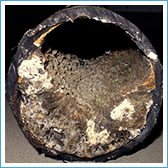
Example of submersible pumping equipment scaling
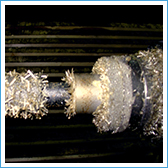
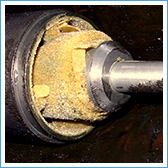
Example of asphaltene-resin-paraffin deposition on submersible pumping equipment
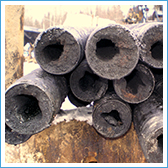
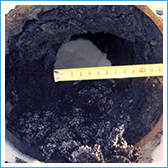
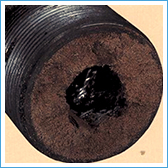
Solid inhibitors are fed into a well using a submersible downhole container (ПСК) installed under the pump. A ПСК con-tainer is a module consisting of solid-bed sections. A section is a hollow cylindrical shell (tubing nipple) which is hydrau-lically bound to the well.
| Solid Inhibitor Type | |
| Description | Inhibitory Action |
| ИСТ, solid inhibitor | Anti-scaling (carbonates, sulphates, etc.) |
| ИКД-ФКБ-1, solid inhibitor | Anti-scaling (carbonates, sulphates, etc.) |
| ИКД-ФКБ-2, solid inhibitor | Anti-asphaltene-resin-paraffin |
| ИКД-ФКБ-3, solid inhibitor | Anti-corrosion |
| All inhibitors by NOVOTEX LLC have the required permits and compliance certificates for use in oil-and-gas industry. | |
Novotex LLC manufactures the following types of ПСК containers
A ПСК container designed as sections filled with a solid inhibitor.
Length = 1500 mm to 2000 mm, Ø 73 mm
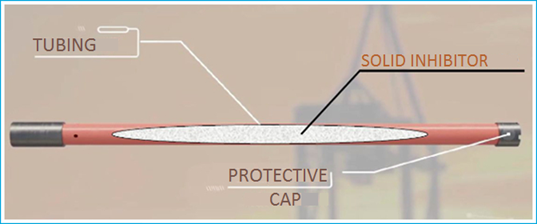
A ПСК container designed as sections filled with chemically neutral solid-reagent-filled capsules.
Length = 2000 mm to 2500 mm, Ø 73 mm to 89 mm
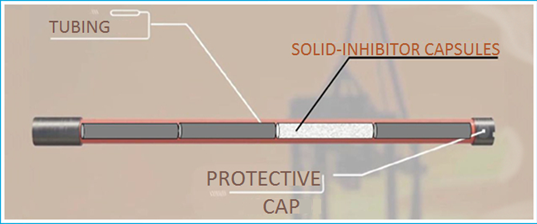
Advantage of Capsular Reusable Containers
1. A non-reusable ПСК container, and third-party counterparts thereof.
This container comprises several sections of 73-mm or 89-mm diameter with a solid inhibitor inside the metallic section (powder, pellets, paste, capsules):
- A high amount of reagent can be enclosed in the section but the inhibitor cannot be replaced directly at the wellsite, nor can the container be disassembled in order to perform the acceptance and quality check of the in-hibitor at the storage.
- Total replacement in case of emergency pulling.
- The design precludes long-time storage in humid climate because the solid inhibitor is hygroscopic, and can react with the wall of the metallic section forming solid, insoluble deposits (iron salts) which reduce the inhibitor con-tainer performance.
2. A capsular reusable ПСК container by Novotex LLC has specific advantages over third-party counterparts.
This container comprises several sections of 73-mm or 89-mm diameter enclosing chemically neutral, solid-inhibitor-filled capsules
Operating temperature of the capsules: up to 170°С.
This container has the following advantages over the non-reusable one:
- The inhibitor carryout can be customized to a particular well.
- The capsules can be replaced just before running the container (in case of emergency pulling).
- Several types of inhibitors can be simultaneously used inside the same ПСК container.
The capsules are entirely (the walls and the cap) made of a chemically neutral material with high melting temperature of up to 170°C.
During storage and transportation, the capsules enclosing a solid reagent prevent the chemical from contacting the in-ner metallic wall of the container section which has a beneficial effect on the container performance and on the inhibitor feeding, and prevents formation of iron salt crystals.
This is because the chemical basis of the solid antiscalant is a hydroscopic, powdery organic acid which, as the ambient humidity increases, can react with the container section wall metal thus forming solid, insoluble deposits (iron salts) which block the container section channels and considerably reduce the container performance. A reusable container with solid inhibitor enclosed inside chemically neutral capsules is free of the above disadvantages.
Advantage of the Solid Inhibitor Feeding Mode in the ПСК Container
- 100% active inhibitor basis
- The solid inhibitor is continuously dispensed into produced fluids due to gradual dissolution of the active basis
- Scaling is prevented
- Submersible oilfield equipment is protected against asphaltene-resin-paraffin deposition along the entire path-way of inhibitor-saturated water- oil flow
- The time between overhaul (TBO) and the cleaning interval (CI) of a producing well are increased
- Once installed in a well, a ПСК container needs no maintenance
- After a well is started up, the inhibitor-ubti0fkuid dispensation begins instantaneously
- Submersible pumping equipment is protected at the initial stage of post-overhaul operation
Application of a Solid Inhibitor inside a ПСК Container
- Artificial (SRP, ECP, sucker-rod screw pump), and free-flow production method
- Water cut = 5% to 100%
- Reservoir temperature = 10°C to 170°C
- Simple and robust dispenser design
- Comprehensive action: scaling and asphaltene-resin-paraffin deposition are prevented inside tubing and in bottomhole zone, submersible pumping equipment is protected against corrosion
- With fluid rate of up to 120 m³/d, mean inhibitor operation time of a ПСК container is up to 360 days
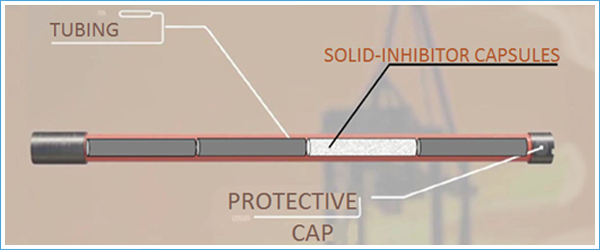
Example of ПСК Container Installation
A submersible downhole container is attached to the ESM base or to the telemetering system using an adapter, and run in. The ПСК design ensures that the reagent can be fed directly to the ESP inlet.
- Container length: 8 m to 30 m
- The bottom container section is located 10 m to 30 m above the perforated interval
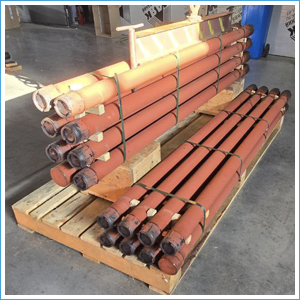
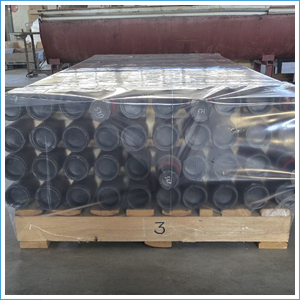
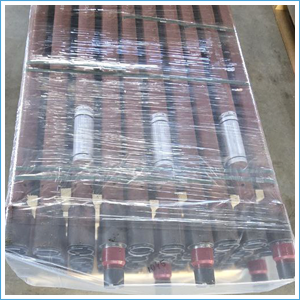
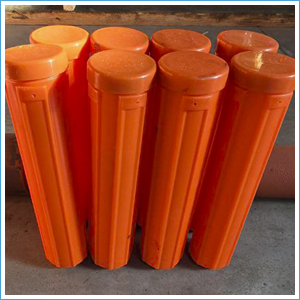
Product Photos
Types and Characteristics of the ПСК Container with a Solid Inhibitor
| Codename | Maximum Reservoir Fluid Rate, m3/d | Section No., Pcs | Dimensions, mm |
| ПСК 73-6 container | up to 50 | 6 | 1.5-m section:90002-m section: 12000 |
| ПСК 73-8 container | up to 100 | 8 | 1.5-m section:120002-m section: 16000 |
| ПСК 73-10 container | up to 120 | 10 | 1.5-m section:150002-m section: 20000 |
| ПСК 73-12 container | up to 150 | 12 | 1.5-m section:180002-m section: 24000 |
The ПСК types are given approximately, and are customized to the particular operating conditions. A ПСК con-tainer of 89-mm diameter with similar characteristics can be fabricated.

Sulphate/Carbonate Scaling Inhibitors
- With fluid rate of up to 120 m³/d, mean operating time of a solid inhibitor container can be as long as 360 days
- As of 1ˢᵗ Sept., 2024, more than 10000 wells in various regions of Russia were equipped with solid inhibitor containers. This caused the TBO to increase 1.3 time to 6.1 time, the CI 1.2 time to 13.8 time (anti- asphaltene-resin-paraffin inhibitor), the TBO 1.5 time to 13.7 times (antiscalant)